Dolby Pro Logic is a family of matrix-surround decoders. They analyse relationships between the left and right signals to derive additional speaker feeds. Stereo and matrix-encoded material can therefore be played through a surround-speaker arrangement without containing a separate encoded track for every output channel.
Follow the progression below: Pro Logic creates one surround feed, Pro Logic II creates separate left and right surround feeds, and Pro Logic IIx adds back-surround feeds for a compatible 7.1 layout. IIz is a separate height/ambient option, explained afterwards. These are simplified signal-flow illustrations, not detailed decoder algorithms.
See the channel differences
Pro LogicOriginal matrix surround
Stereo inputL + R
↓
Pro Logic decoder
↓
4 derived feeds
Front Left (FL)
Centre (C)
Front Right (FR)
Mono Surround (S)
The same surround feed may be played through more than one rear speaker.
Pro Logic IISeparate stereo surrounds
Stereo inputL + R
↓
Pro Logic II decoder
↓
5 derived feeds
Front Left (FL)
Centre (C)
Front Right (FR)
Surround Left (SL)
Surround Right (SR)
Separate surround feeds create a more spacious rear soundfield than the original mono surround.
Pro Logic IIxBack-surround expansion · 7.1 PCM layout
Stereo or compatible surround inputDecoded PCM processing
↓
Pro Logic IIx processing
↓
7 main speaker feeds
Front Left, Centre, Front Right
Surround Left, Surround Right
Back Left (BL)
Back Right (BR)
Extends the surround field behind the listener. Back feeds are derived, not separate channels recovered from stereo.
Subwoofer note: None of these two-channel matrix examples contains a separate, encoded LFE track. A system can still drive a subwoofer through bass management. The notation “5.1” or “7.1” may describe a physical speaker arrangement, not additional discrete channels in the stereo input.
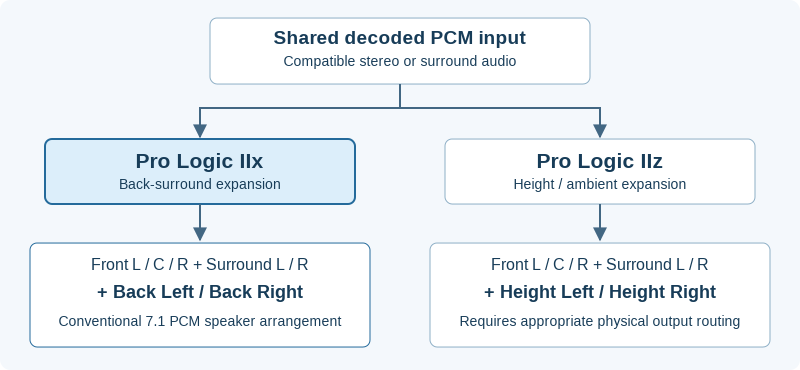
IIx and IIz share a starting point — their extra outputs differ
Both work on compatible decoded audio. The shared flow below separates the IIx back-surround route from the IIz height/ambient route. They are alternative processing choices in this explanation, not consecutive stages.
Speaker feeds are shown without a separate LFE channel. Subwoofer output depends on source decoding or bass management. Open or save the shared block diagram.
For conventional 7.1 speakers, the relevant choice is IIx. IIz requires an appropriate height/ambient arrangement. In CW-Surround, the IIz height/ambient pair occupies BL/BR output slots; those slot labels alone do not make it rear-surround IIx processing.
Enhanced DSP, IIx and decoded-audio expansion
CW-Surround is the modification that integrates these matrix decoders and expansion features into LAV Audio Decoder. Media Player Codec Pack 5.5.5 includes the following processing choices. They extend the playback chain; they do not introduce new file extensions.
Setting
Input and purpose
Output distinction
Dolby Pro Logic Enhanced (DSP)
Custom Pro Logic enhancement with derived rear presence.
DSP-generated ambience; not additional discrete channels stored in the recording.
Dolby Pro Logic IIx
Rear-surround expansion with an appropriate 7.1 PCM layout.
Back-surround feeds, rather than IIz height/ambient feeds.
Dolby Digital expansion: EX / IIx / IIz
Optional expansion after Dolby Digital has been decoded to PCM.
EX, IIx and IIz have different surround or height purposes; choose a mode suited to the speaker arrangement.
DTS expansion: ES
Optional ES processing after DTS has been decoded to PCM.
Derived surround expansion is distinct from discrete DTS-ES source-channel decoding.
PCM processing is required. Direct AC-3 or DTS bitstream passthrough leaves decoding and expansion to the receiving equipment. Available options depend on the output layout and renderer. A standard S/PDIF AC-3 output does not transport a discrete 7.1 PCM layout.
Dolby Pro Logic Enhanced (DSP): presence-inspired ambience
Dolby Pro Logic Enhanced (DSP) is a custom CW-Surround mode inspired by the sense of space and presence associated with Yamaha DSP presence processing. It combines Pro Logic decoding with derived rear-presence ambience to create a more enveloping soundfield. The added ambience is generated during playback; it is not extra discrete audio stored in the source.
This is an independent CW-Surround implementation, not a Yamaha DSP implementation or an official Dolby decoding mode. Choose it for an enhanced ambience presentation, or use Pro Logic II / IIx when you prefer those surround-decoding options.
SQ and QS quadraphonic playback
For two-channel SQ or QS / Quark recordings, use CW-Matrix in MPC-DAP from Plus. These matrix encodings are separate from Dolby Pro Logic and the LAV expansion controls. CW-Matrix supports its own SQ, QS, Dolby Surround, Pro Logic I, Pro Logic II and Stereo modes; the new LAV Enhanced/IIx/EX/ES controls should not be assumed to exist in CW-Matrix.
Pro Logic, II and IIx — with IIz as a separate option
Mode
Main output feeds shown
What changes?
Pro Logic
FL, C, FR, S
Single mono surround feed
Pro Logic II
FL, C, FR, SL, SR
Independent surround-left and surround-right feeds derived by the decoder
Pro Logic IIx
FL, C, FR, SL, SR, BL, BR
Adds derived back-left and back-right surround feeds for a compatible 7.1 arrangement
Pro Logic IIz
FL, C, FR, SL, SR, FHL, FHR
Adds two derived front-height feeds; output configurations depend on equipment
The original Pro Logic surround channel also had more limited bandwidth than modern surround channels. Pro Logic II improves surround separation; IIx extends the rear soundfield, while IIz concerns height/ambient processing. Results vary by source material and decoder implementation.
How does matrix decoding work?
When a surround mix is encoded into two channels, differences in level and phase can carry spatial cues. A matrix decoder examines these cues and steers sound toward the appropriate speaker feeds. Ordinary stereo music can also be processed, though the results may differ from material specifically mixed for matrix surround.
This is not the same as decoding discrete Dolby Digital 5.1 or DTS 5.1, where individual channels are represented in the encoded soundtrack. Nor does Pro Logic IIz create the same kind of height information as object-based Dolby Atmos.
Using CW-Surround in LAV Audio Decoder
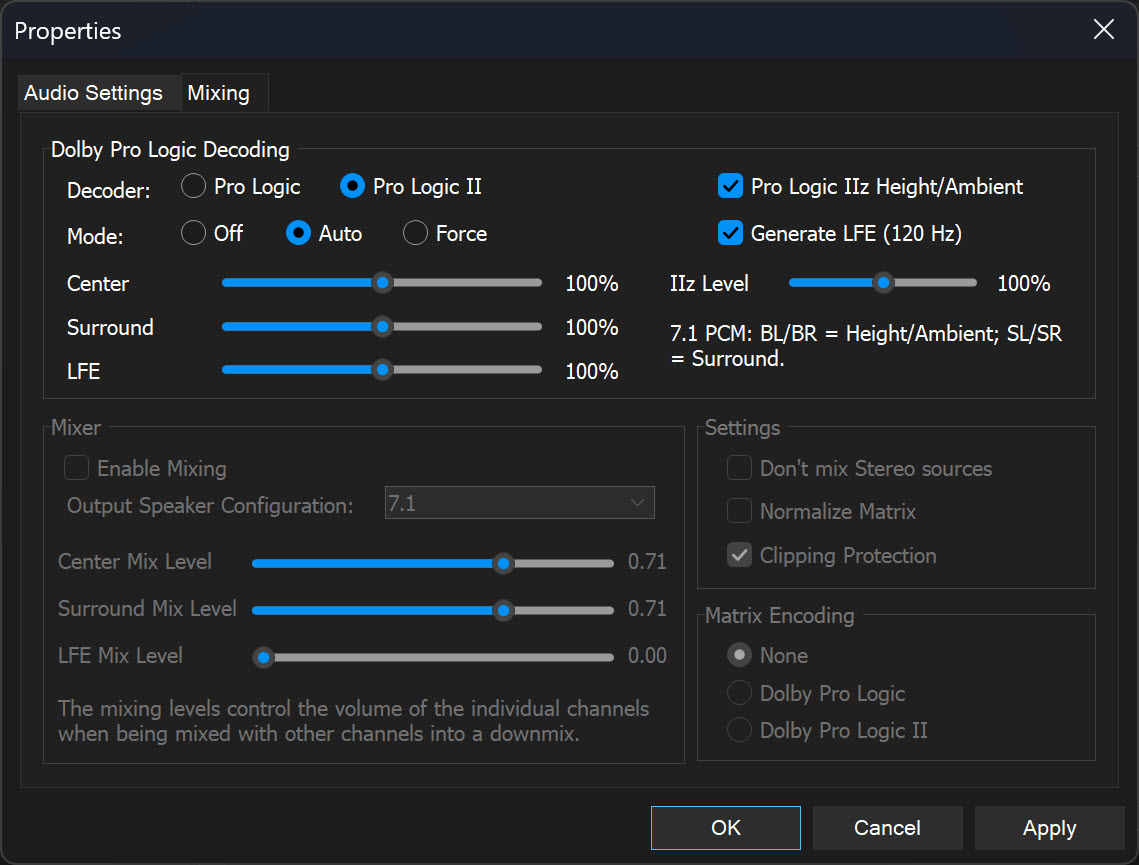
Earlier LAV Audio Decoder controls, shown for the original Pro Logic and IIz explanation. The 5.5.5 build includes additional controls described above. Select the image to enlarge.
The codec pack incorporates these controls directly into a patched version of the LAV Audio Decoder mixer. They are not a separate surround-sound program or a feature of unmodified upstream LAV Filters. Open LAV Audio Decoder Properties → Audio Settings to find the Dolby Pro Logic Decoding section shown here.
Decoder and operating mode
Select Pro Logic for the original mono-surround matrix decoder, or Pro Logic II for separate left and right surrounds. Off disables this processing; Auto allows the decoder to select it when appropriate; and Force requests matrix decoding. Auto is a sensible starting point for ordinary playback.
IIx back surrounds for 7.1 output
Choose Pro Logic IIx for derived back-left and back-right surround feeds in a compatible 7.1 PCM layout. This is part of the CW-Surround modification in LAV Audio Decoder. It is distinct from CW-Matrix in MPC-DAP. An encoded S/PDIF AC-3 output cannot carry this discrete 7.1 PCM layout.
IIz: the separate Height/Ambient option
Enable Pro Logic IIz Height/Ambient when you have a suitable multichannel PCM output arrangement. The IIz Level control adjusts the derived height/ambient contribution; separate Center and Surround controls adjust the matrix-decoded speaker feeds.
Important output mapping: in this patched implementation, when using 7.1-channel PCM, the BL/BR output slots carry the derived Height/Ambient pair, while SL/SR remain the normal surround channels. Windows and connected devices may label BL/BR as back speakers, so physical routing must be configured appropriately before expecting height playback. This is a codec-pack-specific mapping, not a universal Pro Logic IIz channel assignment.
Generate LFE (120 Hz)
The optional Generate LFE (120 Hz) setting can create a low-frequency output from processed audio for a compatible PCM speaker configuration. The LFE slider controls its level. This is generated bass content, not a discrete LFE channel decoded from the original stereo material. Its behaviour and the system's separate bass-management settings should not be confused.
Mixing vs decoding: the screenshot shows the regular LAV Audio Mixer options separately below the Pro Logic controls. The codec pack's Pro Logic decoder is integrated into the audio-decoding path; the greyed-out Mixer section is not proof that Pro Logic processing is disabled. Encoded bitstream passthrough may bypass these PCM processing options.
Frequently asked questions
What is Dolby Pro Logic?
Dolby Pro Logic is a matrix surround decoding system that derives front left, centre, front right and a single mono surround channel from a compatible two-channel signal.
What is the difference between Pro Logic and Pro Logic II?
The original Pro Logic has one mono surround channel. Pro Logic II derives separate surround-left and surround-right channels and offers a more spacious five-main-channel layout.
What does Pro Logic IIx add?
Pro Logic IIx derives back-left and back-right surround feeds for a compatible 7.1 output. It expands the surround soundfield behind the listener; IIz instead derives height/ambient feeds.
What does Pro Logic IIz add?
Pro Logic IIz adds two front-height outputs, derived from suitable source material, to a conventional surround layout. The extra height information is not a discrete object-based soundtrack.
Does Pro Logic II create a real 5.1 soundtrack?
It can produce five main speaker feeds from two-channel content. Its matrix-derived signals are not the same as six independently encoded discrete channels, and the matrix does not carry a dedicated LFE channel.
Does a subwoofer count as a decoded LFE channel?
Not necessarily. A receiver or playback system may send low frequencies to a subwoofer using bass management. That is different from a discrete LFE track encoded in the source.
Where are these settings in Media Player Codec Pack?
Open the installed LAV Audio Decoder properties and select Audio Settings. The codec pack includes patched LAV Audio controls for Pro Logic, Enhanced DSP, Pro Logic II/IIx and Dolby Digital EX/IIx/IIz or DTS ES expansion.
What do Auto, Force and Generate LFE do?
Off disables Pro Logic processing, Auto allows automatic selection and Force requests matrix decoding. Generate LFE (120 Hz) creates a low-frequency output for compatible PCM layouts; it does not recover a discrete LFE track from stereo.
Is Pro Logic IIz the same as Dolby Atmos?
No. Pro Logic IIz derives front-height audio through upmixing; Dolby Atmos is a separate immersive-audio system with different source and rendering capabilities.
Dolby, Dolby Pro Logic and Dolby Atmos are trademarks of Dolby Laboratories. The diagrams are simplified explanations and do not imply Dolby certification of this page or software.