Dolby Pro Logic is a family of matrix-surround decoders. They analyse relationships between the left and right signals to derive additional speaker feeds. Stereo and matrix-encoded material can therefore be played through a surround-speaker arrangement without containing a separate encoded track for every output channel.
The three modes below show the basic idea: Pro Logic creates one surround feed, Pro Logic II creates separate left and right surround feeds, and Pro Logic IIz adds a pair of front-height outputs. These are simplified signal-flow illustrations, not detailed decoder algorithms.
See the channel differences
Pro LogicOriginal matrix surround
Stereo inputL + R
↓
Pro Logic decoder
↓
4 derived feeds
Front Left (FL)
Centre (C)
Front Right (FR)
Mono Surround (S)
The same surround feed may be played through more than one rear speaker.
Pro Logic IISeparate stereo surrounds
Stereo inputL + R
↓
Pro Logic II decoder
↓
5 derived feeds
Front Left (FL)
Centre (C)
Front Right (FR)
Surround Left (SL)
Surround Right (SR)
Separate surround feeds create a more spacious rear soundfield than the original mono surround.
Pro Logic IIzFront-height expansion
Stereo or surround input2-channel illustrated here
↓
Pro Logic IIz processing
↓
5 main + 2 front-height feeds
Front Left, Centre, Front Right
Surround Left, Surround Right
Front Height Left (FHL)
Front Height Right (FHR)
Height signals are derived; no separate height soundtrack is required.
Subwoofer note: None of these two-channel matrix examples contains a separate, encoded LFE track. A system can still drive a subwoofer through bass management. The notation “5.1” or “7.1” may describe a physical speaker arrangement, not additional discrete channels in the stereo input.
Pro Logic vs Pro Logic II vs Pro Logic IIz
Mode
Main output feeds shown
What changes?
Pro Logic
FL, C, FR, S
Single mono surround feed
Pro Logic II
FL, C, FR, SL, SR
Independent surround-left and surround-right feeds derived by the decoder
Pro Logic IIz
FL, C, FR, SL, SR, FHL, FHR
Adds two derived front-height feeds; output configurations depend on equipment
The original Pro Logic surround channel also had more limited bandwidth than modern surround channels. Pro Logic II improved surround separation, while IIz introduced front-height processing. Results vary by source material and decoder implementation.
How does matrix decoding work?
When a surround mix is encoded into two channels, differences in level and phase can carry spatial cues. A matrix decoder examines these cues and steers sound toward the appropriate speaker feeds. Ordinary stereo music can also be processed, though the results may differ from material specifically mixed for matrix surround.
This is not the same as decoding discrete Dolby Digital 5.1 or DTS 5.1, where individual channels are represented in the encoded soundtrack. Nor does Pro Logic IIz create the same kind of height information as object-based Dolby Atmos.
Using Pro Logic in our patched LAV Audio Decoder
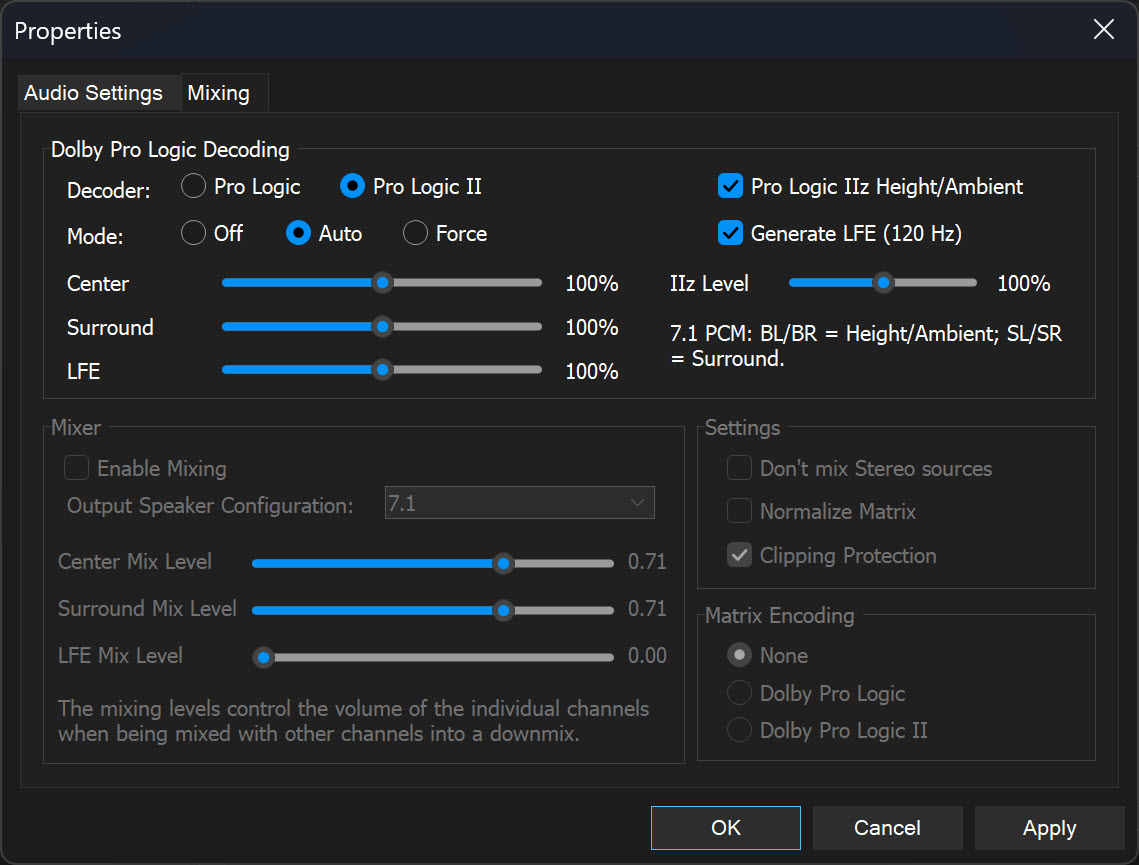
Our LAV Audio Decoder audio settings. Select the image to view the full-size controls.
The codec pack incorporates these controls directly into a patched version of the LAV Audio Decoder mixer. They are not a separate surround-sound program or a feature of unmodified upstream LAV Filters. Open LAV Audio Decoder Properties → Audio Settings to find the Dolby Pro Logic Decoding section shown here.
Decoder and operating mode
Select Pro Logic for the original mono-surround matrix decoder, or Pro Logic II for separate left and right surrounds. Off disables this processing; Auto allows the decoder to select it when appropriate; and Force requests matrix decoding. Auto is a sensible starting point for ordinary playback.
IIz Height/Ambient and channel levels
Enable Pro Logic IIz Height/Ambient when you have a suitable multichannel PCM output arrangement. The IIz Level control adjusts the derived height/ambient contribution; separate Center and Surround controls adjust the matrix-decoded speaker feeds.
Important output mapping: in this patched implementation, when using 7.1-channel PCM, the BL/BR output slots carry the derived Height/Ambient pair, while SL/SR remain the normal surround channels. Windows and connected devices may label BL/BR as back speakers, so physical routing must be configured appropriately before expecting height playback. This is a codec-pack-specific mapping, not a universal Pro Logic IIz channel assignment.
Generate LFE (120 Hz)
The optional Generate LFE (120 Hz) setting can create a low-frequency output from processed audio for a compatible PCM speaker configuration. The LFE slider controls its level. This is generated bass content, not a discrete LFE channel decoded from the original stereo material. Its behaviour and the system's separate bass-management settings should not be confused.
Mixing vs decoding: the screenshot shows the regular LAV Audio Mixer options separately below the Pro Logic controls. The codec pack's Pro Logic decoder is integrated into the audio-decoding path; the greyed-out Mixer section is not proof that Pro Logic processing is disabled. Encoded bitstream passthrough may bypass these PCM processing options.
Frequently asked questions
What is Dolby Pro Logic?
Dolby Pro Logic is a matrix surround decoding system that derives front left, centre, front right and a single mono surround channel from a compatible two-channel signal.
What is the difference between Pro Logic and Pro Logic II?
The original Pro Logic has one mono surround channel. Pro Logic II derives separate surround-left and surround-right channels and offers a more spacious five-main-channel layout.
What does Pro Logic IIz add?
Pro Logic IIz adds two front-height outputs, derived from suitable source material, to a conventional surround layout. The extra height information is not a discrete object-based soundtrack.
Does Pro Logic II create a real 5.1 soundtrack?
It can produce five main speaker feeds from two-channel content. Its matrix-derived signals are not the same as six independently encoded discrete channels, and the matrix does not carry a dedicated LFE channel.
Does a subwoofer count as a decoded LFE channel?
Not necessarily. A receiver or playback system may send low frequencies to a subwoofer using bass management. That is different from a discrete LFE track encoded in the source.
Where are these settings in Media Player Codec Pack?
Open the installed LAV Audio Decoder properties and select Audio Settings. The codec pack includes a patched LAV Audio Decoder mixer with Pro Logic, Pro Logic II and optional IIz Height/Ambient controls.
What do Auto, Force and Generate LFE do?
Off disables Pro Logic processing, Auto allows automatic selection and Force requests matrix decoding. Generate LFE (120 Hz) creates a low-frequency output for compatible PCM layouts; it does not recover a discrete LFE track from stereo.
Is Pro Logic IIz the same as Dolby Atmos?
No. Pro Logic IIz derives front-height audio through upmixing; Dolby Atmos is a separate immersive-audio system with different source and rendering capabilities.
Dolby, Dolby Pro Logic and Dolby Atmos are trademarks of Dolby Laboratories. The diagrams are simplified explanations and do not imply Dolby certification of this page or software.